
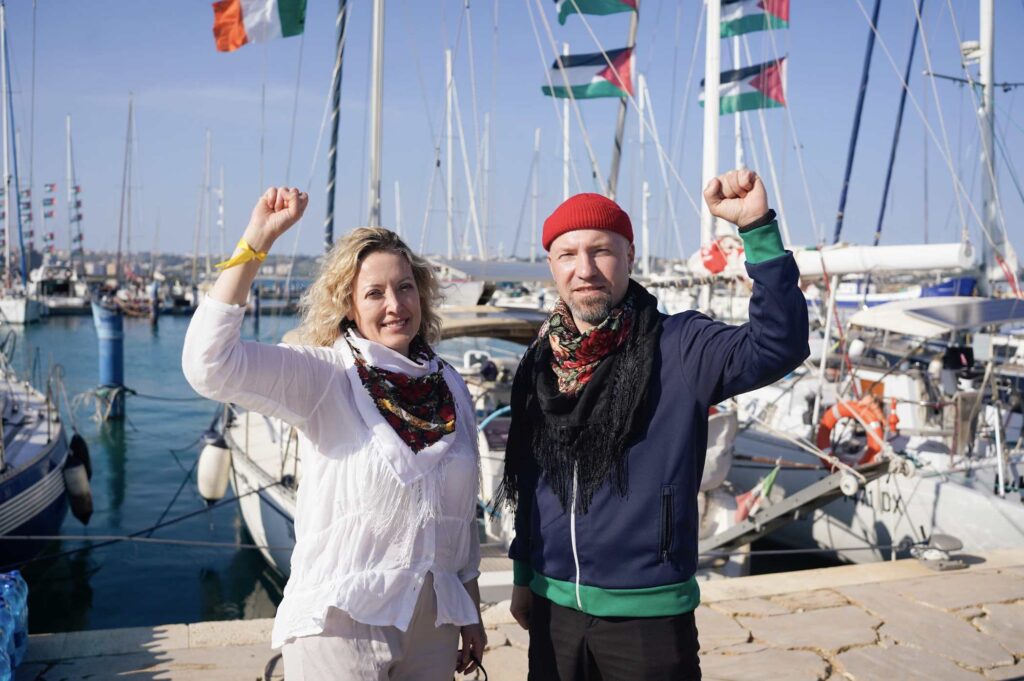
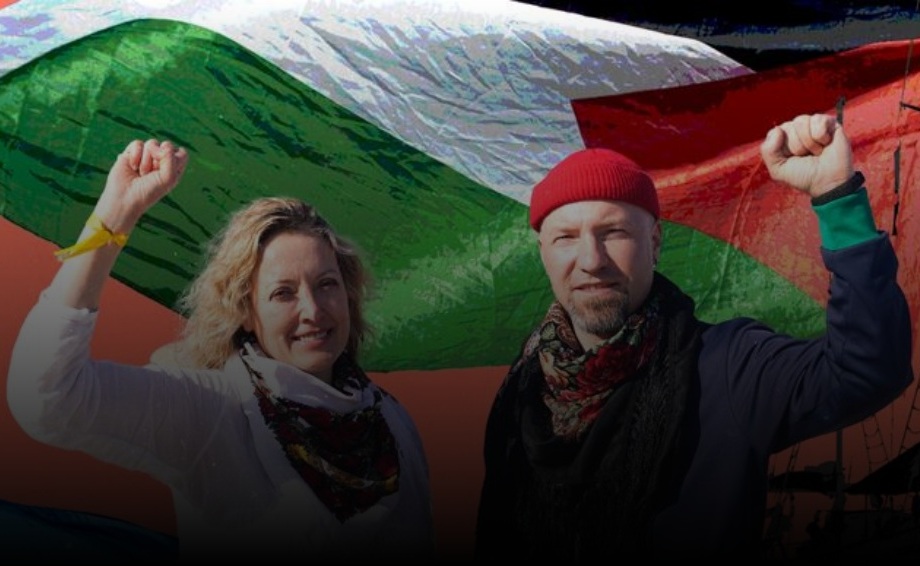
Two Ukrainian activists, Andrii Movchan and Nina Potarska, have been arrested by the armed forces of the genocidal Israeli state.
Israeli Navy’s criminal attack on Gaza flotilla: Ukrainian team among detained crews. Release them all now!
April 30, 2026
The European Network for Solidarity with Ukraine (ENSU) has learned that the vessel carrying the Ukrainian team as part of the Sumud Global Flotilla 2026 was one of those illegally seized by the Israeli Navy early this morning.
According to an Al Jazeera report seven out of the 58 vessels were captured by Israel near Crete, over a thousand kilometres from the coast of Gaza.
ENSU coordinator Szymon Martys described the raid as “a blatant and cynical attack on unarmed vessels navigating peacefully in international waters”. He demanded the immediate release of the detained crews, which include the Ukrainian team of Nina Potarska and Andrii Movchan.
Martys said that ENSU, which is supporting the two Ukrainian peace and human rights activists, had no information as to their situation, but assumed that they, along with other crews, were being held illegally on an Israeli navy vessel.
“They must all be freed immediately”, he added, and called on the Ukrainian government, along with the governments of all the kidnapped crews, to demand their immediate release.
Martys commented that the Israeli’s government’s action–attacking the flotilla when it was far from Gaza and before public attention on its mission would be at a peak–betrayed its fear of the power of international solidarity with the Palestinian people.
“We in the Ukraine solidarity movement understand this truth”, he added. “Powerful governments, like Netanyahu’s and Putin’s, although armed to the teeth, can be brought low by the mass mobilisation of all who stand for the rights of peoples. The Sumud Global Flotilla is symbol of popular indignation at the murderous violence of war and of people’s determination to stand with the oppressed.”
The Ukrainian team had joined the Sumud Global Flotilla to help the humanitarian effort for the blockaded people of Gaza, towards whom they, as members of a nation also victim of brutal invasion, feel a special duty of solidarity.
I invite you to read my new English translation for Спільне / Commons: “Breaking the Gaza Blockade: Ukrainians on the Sumud Flotilla.”
It is a thought-provoking interview with Ukrainian activists Andrii Movchan and Nina Potarska about Gaza, Ukraine, occupation, human rights, and solidarity.
Many thanks to the Commons editorial team for this important conversation and for the careful editorial work. I am grateful for this collaboration opportunity.
Andrii Movchan: “I have been sympathetic to the Palestinian movement since my teenage years. Even then, I understood that there was an occupation there, that people were fighting for their basic rights, which were being brutally violated year after year. I knew that settler colonialism was a real issue. In general, I intuitively understood that the Palestinian cause was a just one. Later, after I had emigrated, I began talking to Palestinians, and they made that conviction even stronger. Because, despite all the complexity of this conflict, the truth is still on the side of the oppressed. And the oppressed side here is, without question, the Palestinian people.”
Nina Potarska: ‘We are convinced that this must be resisted, including through the practice of solidarity and by bringing together the struggles of different peoples. I think my own experience fits into this picture. I have been to Mexico and Colombia, where I spoke with various women’s and left-wing groups. For me, the dividing line is between authoritarian and non-authoritarian leftists. Those who lean toward authoritarianism are more likely to identify with state interests and international coalitions.
For example, in Mexico, the question of Ukraine is not seen in terms of Ukrainians suffering from war, but in terms of resisting US interests. Since they themselves suffer from Washington’s policies, they perceive Russia in a very schematic way — as a distant but “tactical ally” in the struggle against America.
This can be understood, but I place myself on the side of solidarity between people, not states. It seems to me that this is where the main dividing line lies. In the world, Ukraine is still often perceived through its official political positioning, rather than through voices “from below”: activists, humanitarian workers, or human rights defenders.’
See below an extensive interview with Andrii Movchan and Nina Potarska
Link :
Breaking the Gaza Blockade: Ukrainians on the Sumud Flotilla
Breaking the Gaza Blockade: Ukrainians on the Sumud Flotilla
The Ukrainian experience of war is often framed through an East–West geopolitical lens, with Ukraine defending Western values against Eastern barbarism. In this discourse, imperialism is destructive only when it is “Eastern.” But can the Ukrainian experience of war become a source of solidarity not only at home, but also with other oppressed peoples — even people facing wars backed by “our partners”?
Ukrainian left-wing activists Andrii Movchan and Nina Potarska have joined the Global Sumud Flotilla — an international flotilla seeking to reach Gaza by sea and break the Israeli blockade. We spoke with them about the risks of this mission, the situation in Gaza, Ukrainian society, and why solidarity between people, rather than states, matters.
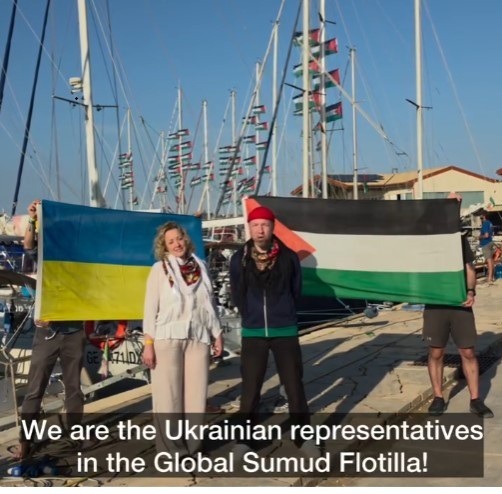
Commons Editorial Board: Tell us a little about yourselves and your background, and how it eventually led you to take part in the Global Sumud Flotilla.
Andrii Movchan: I have been sympathetic to the Palestinian movement since my teenage years. Even then, I understood that there was an occupation there, that people were fighting for their basic rights, which were being brutally violated year after year. I knew that settler colonialism was a real issue. In general, I intuitively understood that the Palestinian cause was a just one. Later, after I had emigrated, I began talking to Palestinians, and they made that conviction even stronger. Because, despite all the complexity of this conflict, the truth is still on the side of the oppressed. And the oppressed side here is, without question, the Palestinian people.
Nina Potarska: For the past 23 years, I have been doing human rights work. My focus is mainly women’s rights. Since the beginning of the full-scale war in Ukraine, I have been in constant contact with people who live and remain in the occupied territories. In addition, I have been working with WILPF — the Women’s International League for Peace and Freedom — for ten years. WILPF is an international feminist anti-war organization, and it is through this organization that I have been in contact for many years with groups and organizations around the world. WILPF has, in particular, a very large group working specifically on the Middle East. So it somehow happened quite organically that I had either already worked with these people or had been in regular contact with them.
When the “new wave” began [another escalation of the conflict between Israel and Palestine — eds.] and the events of 7 October took place, when every possible human right was being violated, it became especially clear how strong double standards are in the UN system. To be honest, I felt ashamed that the attitude of the supposedly civilized international community toward a country suffering from aggression by European countries differs so radically from its attitude toward Ukraine. Toward people I know.
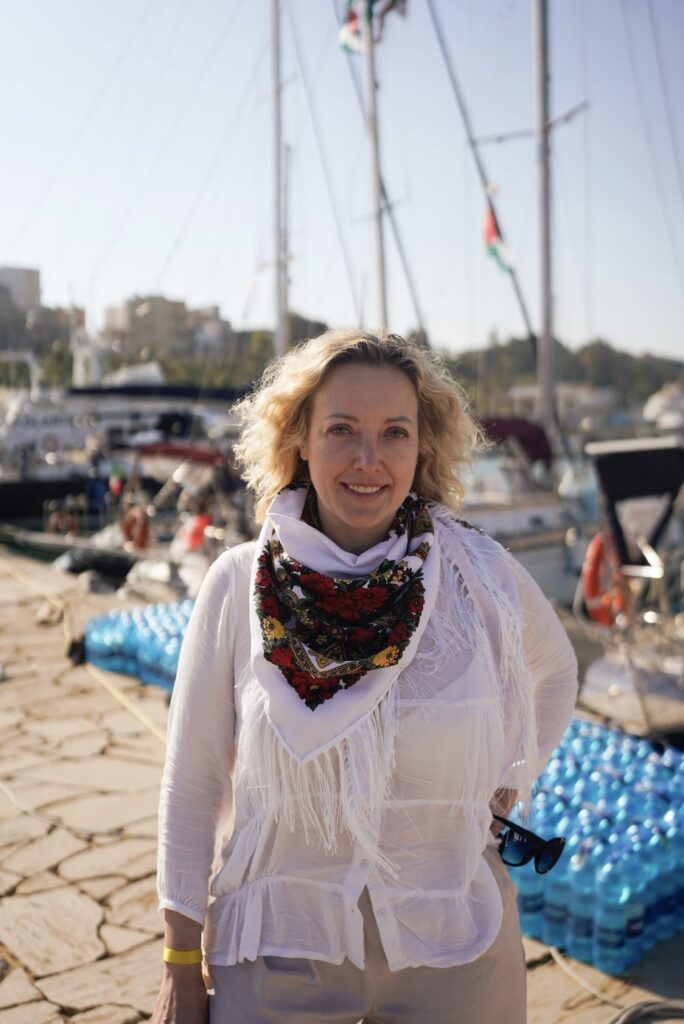
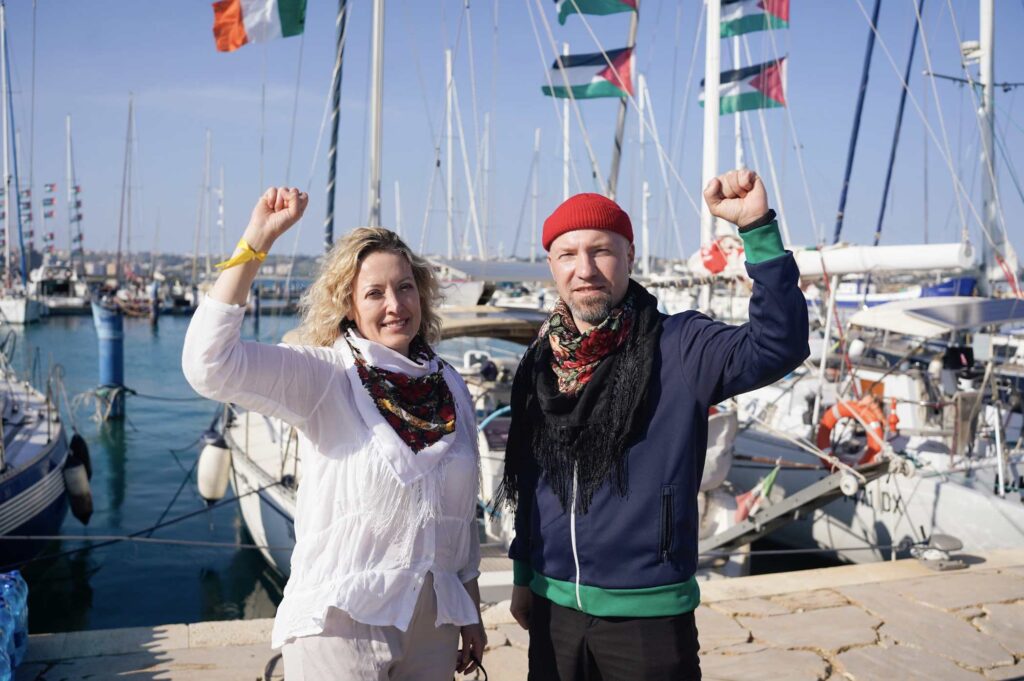
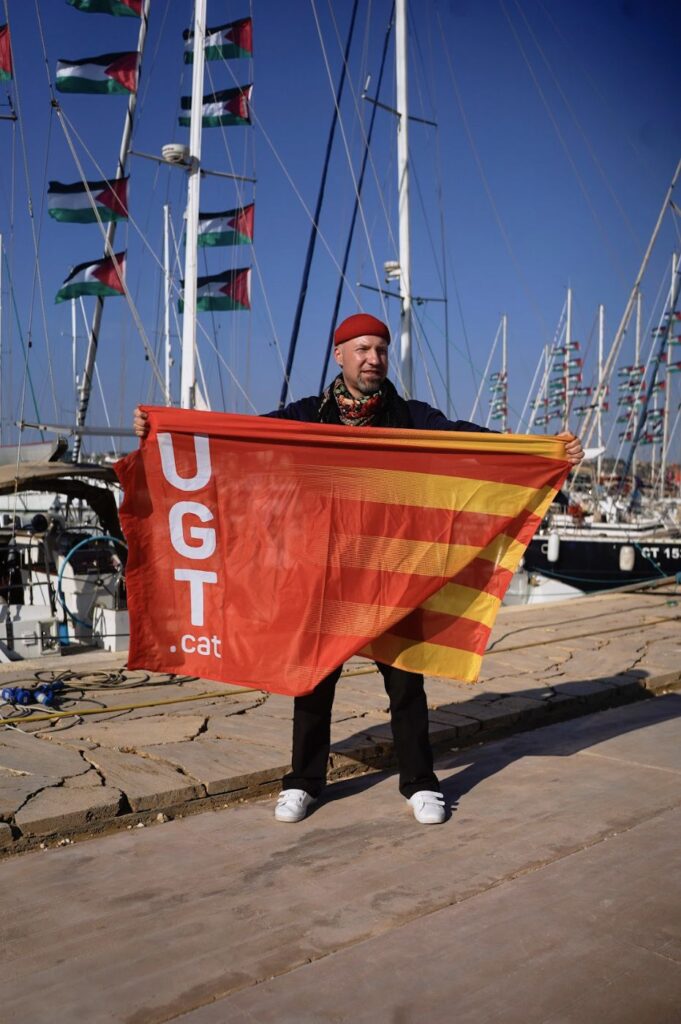
Two years ago, I moved to Canada with my children. But because all the projects I am involved in have to do with Ukraine, I periodically return. And every time I am surprised that Ukraine — the Ukrainian authorities, Ukrainian society — somehow does not associate itself with similarly oppressed, occupied spaces and people who are suffering at the hands of invaders.
In my view, supporting Palestine is something so basic that it is even difficult to put into words. It is about dignity, rights, the general balance of justice, and the role of the state in each person’s system of coordinates. For me, the question of whether this support is appropriate does not even arise. We are against occupation, and to express our position, we make gestures of solidarity with the oppressed.
A.M.: I think it is important to state the key point here: why we decided to do this at all. After the previous flotilla, in September 2025, I had the feeling that my place should be there.
I think there are several levels to this. First, it is direct participation in the struggle against injustice toward the Palestinian people. Second, it is the desire to demonstrate this to our own society, to highlight this issue in a new way. To use language and gestures that are understandable to show events in Palestine from another angle and explain why we should be in solidarity with this people.
And third, no less importantly, it is to show the rest of the world — especially the Global South and people in the West who are involved in pro-Palestinian campaigns — that Ukrainians are not standing aside from this tragedy. That we are not only asking for solidarity for ourselves, but are also capable of showing it toward those who are in a similar, and perhaps even worse, situation.
Even if they are from another, so to speak, geopolitical camp, they are still people like us, people against whom military aggression and occupation are being carried out. I am sincerely convinced that we badly lack this kind of dialogue with the Global South and with the left. Let this be one of the first attempts to establish such contact.
Let’s talk a little about the Global Sumud Flotilla itself. What is it, and what are its core idea, mission, and values? How large is this initiative, and who is taking part in it?
A.M.: The idea is to open a humanitarian corridor into the blockaded Gaza Strip. At present, the Strip is under a full military blockade — both by land and by sea. As a result, after all this fighting — which in fact has still not stopped, even after the peace plan was agreed — the entire area lies in ruins. It is a zone of complete humanitarian catastrophe: all infrastructure has been destroyed, including hospitals; there is a complete lack of sanitation and a shortage of clean water.
People are living in terrible conditions — in tents that flood after the very first rain; rates of disease are extremely high there. And most importantly, there is still hunger. Yes, the critical, most acute moments — which came last summer — have, fortunately, passed, but mass malnutrition continues, and people are still suffering from hunger.
As for humanitarian aid, the paradox is that the UN is able to provide enough of it, but Israel simply does not allow these humanitarian shipments into Gaza on the necessary scale. In other words, these supplies are just sitting at the checkpoints and spoiling. It is impossible to get aid in from outside, including by sea, because the sea is also under blockade by the Israeli navy and border services. This is unquestionably illegal. It runs counter to international law. Israel has no legal right to control the coastal waters of the Gaza Strip. And that is why our mission is to break through the naval blockade, so that a humanitarian corridor can be established and sufficient humanitarian aid can be delivered.
How does the mission plan to establish this humanitarian corridor? As far as I know, there have already been attempts to reach the Gaza Strip by sea to deliver humanitarian aid. Tell us a little about the successes or failures of previous missions.
N.P.: Unfortunately, previous attempts were successful only in terms of media attention. Only one boat came close to reaching the shore. It was said to be only 20 kilometers from shore. That is very close. This time, the plan is to involve more people and more boats. The tactic is this: Israel does not actually have enough capacity now to intercept the whole flotilla — last time, they almost exhausted their capacity. Besides, Israel is now preoccupied with another war. There is hope that at least some of the boats will manage to reach the shore.
The boats that approached last time were seized, and the participants themselves were detained. Some people were released almost immediately, after a few hours, while others were released after several days. There was a formal process of detention and deportation.
As part of the flotilla, we received training where we were told how to behave if we were arrested. Unfortunately, the chances of being detained and then deported back to one’s home country are very high. All the participants understand this. During the training, I heard that Israeli authorities treat ethnic Palestinians very differently — even during detention. People identified as Palestinian by origin are treated differently. Many activists confirm that both detention and time spent in prison differ depending on your passport. To put it bluntly, whether you are beaten and how long you are held depends primarily on your citizenship.
A.M.: This time, around 80 boats are sailing, with about a thousand participants from different backgrounds. There are professional sailors who have volunteered to sail the boats, media activists, and humanitarian workers. Among them are doctors and teachers, who are desperately needed in Gaza. There are also reconstruction specialists, because everything there has been destroyed and needs to be rebuilt.
N.P.: Our main task is to reach the shore. It’s clear that there will be detentions, but those who are not arrested must form a corridor and keep it open for other boats, which will then be able to arrive quickly from Turkey and other neighboring countries. The minimum goal is to ensure compliance with international law — that is, to make sure that Gaza’s waters are not illegally controlled by the Israeli occupation forces.
What reaction do you expect from the Israeli authorities? You have already mentioned arrests and deportations. Do you expect a military response?
A.M.: During previous missions, there were dramatic events, such as the incident involving the Turkish ship Mavi Marmara. A civilian ship was stormed then, and ten people were killed as a result. The activists resisted: they tried to fend off helicopters — even with slingshots — and to disarm the armed special forces who had landed on deck. It was precisely this confrontation that led to an escalation of violence and to loss of life. After that incident, the tactics were fundamentally revised. The actions of unarmed people against elite naval commandos were extremely brave, but they proved irrational and ineffective.
Since then, the main principle of the mission has been strict non-violence.
N.P.: If a vessel is seized or people are arrested, participants are supposed to remain peaceful and not resist, so as not to endanger themselves or the other vessels, and, above all, to avoid further casualties.
A.M.: We hope that everything will go relatively calmly, as far as possible, given that interception is likely. First, Israel currently has serious problems with its international reputation, and its actions are under close and critical scrutiny from the international press. Second, the mission includes many citizens with “strong passports” — people from the United States, Canada, EU countries, Australia, and Japan. Obviously, in such circumstances, it is much harder for the security forces to treat us the way they usually treat Palestinians in the occupied territories. That is why we have good reason to hope that this time there will be no serious violence.
How does the selection process for the Global Sumud Flotilla work? Do participants have to meet certain requirements?
A.M.: I think we cannot disclose all the details of the organizational process here, including for security reasons, especially operational security. But in general, there are several basic principles.
N.P.: There was an application form on the official website. After that, apparently, each country had a representative or activist group responsible for selecting candidates. I went through this stage with the Canadian group.
The application form includes fields for country of residence and citizenship. Although Andrii and I applied as representatives of Ukraine, he eventually went through the Spanish group, while I went through the Canadian one. Later, however, the Canadian team noted that since I have only a Ukrainian passport and have no formal status in Canada, they would not be able to “cover” me legally. I was advised to contact, for example, the Polish group.
These details highlight the importance of having a “strong” passport. Some national groups have strong legal support and considerable influence. In some countries, the lists of people who wanted to participate were extremely long, so there was a careful selection process, although the exact criteria remain an internal matter for the organizers.
Tell us a little more about participants from countries on the global periphery, or the so-called Global South.
N.P.: In fact, there are not that many people from the Global South here. There is a Turkish group and Palestinians who may have other passports but are ethnically Palestinian.
A.M.: People from Global South countries were more widely represented in Barcelona. We are starting from Sicily, while the first part of the flotilla, at the time of our interview, had already left Barcelona a week earlier. I saw that group off. There were many people from Malaysia, Indonesia, and South Africa. Latin America is very well represented too: Argentina, Brazil, and other countries.
According to the plan, the first group is supposed to join us in Italy, and then we will continue together. We cannot disclose the next point on the route. At each “stop,” we wait for new boats, regroup, and sail on.
Interestingly, from the post-Soviet region, there was only one guy from Lithuania in the previous flotilla. Now, as far as I know, the Ukrainian group is the only one representing this region. There are no activists here from Russia, Belarus, or any other post-Soviet countries. In a certain sense, we are pioneers.
Do you think this shared grassroots experience of solidarity could serve as a practical basis for future shared understanding within the global left, grounded in anti-imperialist principles and human rights?
N.P.: We did not know in advance who exactly would be among the participants, but every day we meet people who have spent time in Ukraine, either some time ago or very recently. Some worked there as medics; others were involved in humanitarian missions. For example, there is a woman from the Netherlands with us, a member of the Greens: she told us that they had just sent another humanitarian shipment to Ukraine.
There is also a guy from Turkey here who is in contact with Serhii Movchan from Solidarity Collectives. So it turns out that these people are not only sailing to Palestine — they also helped Ukraine, although we knew nothing about this before.
It seems to me that the opportunity to highlight their participation and this shared solidarity is extremely important. I did not even expect to meet so many like-minded people here — journalists, medics, activists. They are a special kind of people: activists, leftists, anarchists who live in line with the principle of solidarity. And Ukraine, like Palestine, is part of their field of concern and action.
A.M.: Still, in fairness, it should be said that not all leftists extend their solidarity to both peoples resisting occupation. In Southern Europe and Latin America in particular, there are influential groups of “campists.” These are mostly Stalinist or post-Stalinist movements, or movements strongly influenced by such tendencies.
These people see the world in black and white: there is “our” camp, which includes anyone who opposes the United States, and then there is everyone else. This simplified scheme allows them to make appalling judgments very confidently — even to the point of denying Ukraine’s right to exist.
N.P.: We are convinced that this must be resisted, including through the practice of solidarity and by bringing together the struggles of different peoples. I think my own experience fits into this picture. I have been to Mexico and Colombia, where I spoke with various women’s and left-wing groups. For me, the dividing line is between authoritarian and non-authoritarian leftists. Those who lean toward authoritarianism are more likely to identify with state interests and international coalitions.
For example, in Mexico, the question of Ukraine is not seen in terms of Ukrainians suffering from war, but in terms of resisting US interests. Since they themselves suffer from Washington’s policies, they perceive Russia in a very schematic way — as a distant but “tactical ally” in the struggle against America.
This can be understood, but I place myself on the side of solidarity between people, not states. It seems to me that this is where the main dividing line lies. In the world, Ukraine is still often perceived through its official political positioning, rather than through voices “from below”: activists, humanitarian workers, or human rights defenders.
I now do a lot of international advocacy, and I have not had conflicts with colleagues or women’s groups from Africa and the Middle East. But this is precisely the horizontal level that stands in opposition to state policy or to the official representation of a nation through state interests.
Since the beginning of the full-scale invasion, there has been a view that the world’s attention should be focused entirely on Ukraine, and that any dispersal of this attention toward other conflicts only harms us. In other words, why are you helping Gaza when help is needed at home?
A.M.: In the context of the flotilla, it seems to me that this is one form of helping Ukraine. It is a form of people-to-people diplomacy — a way to build bridges with sectors that are currently being completely ignored by our civil society and diplomatic service.
This is something that few people besides us can really do. That is why I consider this mission important not only for directly supporting Palestinians, but also for making Ukraine visible in places where we have still not been heard.
N.P.: If we think in terms of solidarity, we should remember that the state often does not represent the real needs and views of the people it is supposed to represent. Because of this, Ukrainians in Europe, America, or Latin America — refugees are now everywhere, after all — find themselves in complicated, and sometimes even dangerous, situations. For example, in Poland, we are often no longer welcome.
For people in many countries, the war in Ukraine has come to be associated with a drain on resources: people feel that they are becoming poorer, and this negativity, and sometimes even day-to-day hostility, is directed at Ukrainians. We are seen as people who care only about themselves, who always think everyone owes them something, while supposedly being indifferent to the needs and problems of other peoples. This is a somewhat egocentric position, and it makes it very difficult for other activist groups and solidarity communities to find common ground with us.
Have you had any political discussions with colleagues from abroad, including on the question of low support for Palestine among Ukrainians?
N.P.: So far, we have not really had any discussions, because at first we were tense and anxious amid all the uncertainty. After arriving, we put our trust in the organizers, who are training and preparing us. What is happening here is not so much ideological preparation — although the concept of the flotilla and the events in Gaza have also been discussed — as working through the technical details. We have already spent one day on the boat: washing it and preparing it for departure. Tomorrow we have additional training sessions, including medical training. There are so many organizational issues that there is simply not enough time or space for political discussions. On the contrary, we are now looking for contacts among people we could work with or interview, or people who have already worked in Ukraine, or at least understand the context of what is happening there.
During the first week, we are trying to find our bearings: where we are, who we are, what we can do here, and how to act safely. Many security measures have been introduced here, and since we have already agreed to take part and cooperate, we have to trust the coordinators on technical and organizational matters.
A.M.: As for political discussions, I did have certain concerns. Given the significant influence of Stalinist tendencies in Southern Europe, I felt somewhat anxious. But when we began meeting people, I was pleasantly surprised by how open, positive, and undogmatic they were.
It has really made a strong impression on me. Perhaps we have just been lucky. I suppose fate itself is, for now, protecting us from meeting people we would rather not encounter.
In your view, why are people from the post-Soviet space less willing to join initiatives in support of Palestine?
N.P.: I think it has to do with language and with the fact that we were not a British colony or part of the Commonwealth. Our context is somewhat different. In Ukraine, generally speaking, not many people are interested in global processes, and international news coverage is especially weak now. People’s perception of what is happening in the world is becoming increasingly insular. This is a very worrying trend.
A.M.: There are many factors that could explain why Israel’s position gets more sympathy among Ukrainians. There are fairly objective reasons for this, including the fact that Israel is a very Westernized society. In terms of culture and way of life, it is much closer to ours than other societies in the Middle East. Because of this, when you see the skyscrapers, the beaches of Tel Aviv, or the nightclubs, this seems much more familiar than images of the Muslim world, its poor neighborhoods and large families, although Israeli settlers also usually have large families.
Another factor is that Israel has a huge Russian-speaking post-Soviet diaspora. It seems to me that almost everyone knows someone — an acquaintance, neighbor, or relative who ended up there, and this creates a certain channel of communication.
N.P.: And, of course, there is the tragedy of the Jewish people during the Second World War. These losses and this injustice are more present in our collective memory. Perhaps we simply feel more sympathy for the tragedy of the Jewish people. And this is despite the fact that even before the full-scale war, there were attacks on synagogues in Ukraine. Of course, in recent years the situation has changed radically.
For many Ukrainians, Israel itself is seen as a model — its army and its ability to withstand a hostile environment. These were always the messages promoted in the Ukrainian public sphere.
Previously, people were not very interested in international politics or events in other countries. But what is happening in Palestine is not only the mass killings taking place now; it is part of a longer history. It is decades of illegal arrests — including of children — and inhumane living conditions. It’s a bit like the Donetsk and Luhansk regions now: I often hear from people living there that first they were “not Ukrainian enough” for some people, and now they are “not Russian enough” for Russia. It is a kind of grey zone that everyone manipulates, that everyone fights over, but in reality no one is interested in the people who live there. And what is happening in Palestine often reminds me of something similar.
Even before Israel began its ground operation, we rarely heard about the conditions in which people there were living, about violence against or illegal detentions of Palestinians. Nor about the fact that people literally have no access to basics. When we were in Canada, I met several Palestinians. They were constantly trying to buy basic things — toothpaste, hygiene products — because those were simply impossible to find back home. We need to understand the conditions in which these people lived for many years. What happened later was the culmination of this, a response to one injustice with another.
A.M.: It should also be added that the power of propaganda must not be underestimated. Israel has an extremely powerful propaganda machine. We know Russian propaganda well, but Israeli propaganda is no less effective — and perhaps much more effective. Entire units are working on it, using artificial intelligence — everything is organized extremely well.
Given that 20 percent of Israel’s population is Russian-speaking, just look at what appears in our YouTube feeds: they are packed with Israeli political, economic, and military experts. What we hear about conflicts in the Middle East is mostly presented through the lens of Israeli war propaganda. This is Russian-language content to which we have access, unlike Arabic-language content.
Unfortunately, Israeli propaganda succeeds in manipulating Ukrainian society, traumatized by war. When you are told, “Hey, friend, we are in the same geopolitical camp, it is simple — choose a team and root for it,” this crude and simplistic scheme is easy to accept.
But if we remember the principles on which Ukrainian resistance to Russian aggression is based — opposition to imperialism, resistance to colonial conquest, and respect for international law — these are exactly the things Palestinians have been demanding for themselves for decades. Perhaps this is where we should look for the keys to understanding the conflicts in the Middle East.
Authors:Editorial board of Spilne/Commons, Andriy Movchan, Nina Potarska
Translation: Pavlo Shopin


Leave a Reply